

Book Marketing Timeline: A Month-by-Month Guide

Ask most authors when their book marketing timeline starts and they’ll say “a few weeks before launch.” That’s the single most common reason a launch underperforms. The moves that matter most, reviewer outreach, list building, media pitching, need months to work, not weeks, and a timeline that starts too late can’t make up the difference no matter how much gets crammed into the final stretch.
Why the timeline matters more than the task list
A task list tells you what to do. A timeline tells you when, and when is what most authors get wrong. Advance reader copies sent out four weeks before launch instead of four months don’t just arrive late, they arrive too late to generate the trade reviews and early buzz they’re built for. A media pitch sent the week of launch is competing with the actual news of the book being out, instead of building toward it.
We build book marketing timelines around a four to six month runway before publication. That’s not an arbitrary number. It’s roughly how long it takes an advance reader copy to reach a reviewer, get read, and result in a published review before pub date, and how long a media list takes to build well enough that pitches land with the right people instead of a generic blast.
The book marketing timeline, six months to launch day
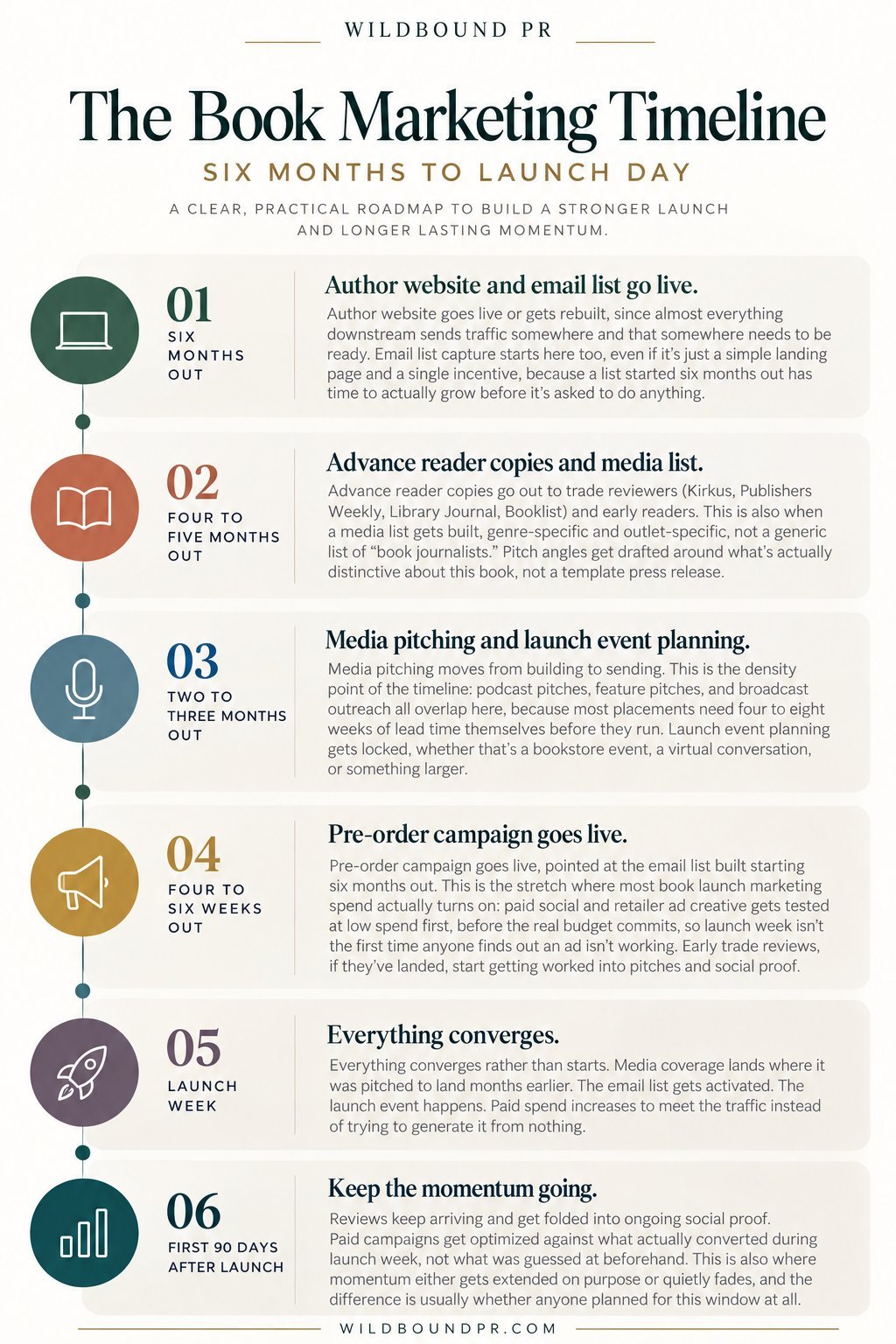
Six months out. Author website goes live or gets rebuilt, since almost everything downstream sends traffic somewhere and that somewhere needs to be ready. Email list capture starts here too, even if it’s just a simple landing page and a single incentive, because a list started six months out has time to actually grow before it’s asked to do anything.
Four to five months out. Advance reader copies go out to trade reviewers (Kirkus, Publishers Weekly, Library Journal, Booklist) and early readers. This is also when a media list gets built, genre-specific and outlet-specific, not a generic list of “book journalists.” Pitch angles get drafted around what’s actually distinctive about this book, not a template press release.
Two to three months out. Media pitching moves from building to sending. This is the density point of the timeline: podcast pitches, feature pitches, and broadcast outreach all overlap here, because most placements need four to eight weeks of lead time themselves before they run. Launch event planning gets locked, whether that’s a bookstore event, a virtual conversation, or something larger.
Four to six weeks out. Pre-order campaign goes live, pointed at the email list built starting six months out. This is the stretch where most book launch marketing spend actually turns on: paid social and retailer ad creative gets tested at low spend first, before the real budget commits, so launch week isn’t the first time anyone finds out an ad isn’t working. Early trade reviews, if they’ve landed, start getting worked into pitches and social proof.
Launch week. Everything converges rather than starts. Media coverage lands where it was pitched to land months earlier. The email list gets activated. The launch event happens. Paid spend increases to meet the traffic instead of trying to generate it from nothing.
First 90 days after launch. Reviews keep arriving and get folded into ongoing social proof. Paid campaigns get optimized against what actually converted during launch week, not what was guessed at beforehand. This is also where momentum either gets extended on purpose or quietly fades, and the difference is usually whether anyone planned for this window at all.
We walk through this same sequence, channel by channel, in how to promote your book, and cover how owned, earned, and paid pieces of the timeline interact in how to market your book.
What happens if you start late
Most authors don’t come to a timeline with six clean months ahead of them. If less time is available, the order to protect is: author website and email list first, because everything else depends on having somewhere to send people. Media pitching next, even compressed, since some coverage is better than none. Advance reader copies and trade reviews are the hardest to compress. A review outlet with an eight-week reading window doesn’t move faster because the launch date got moved closer. That piece either has the lead time or it gets dropped, and it’s better to know that early than to discover it in week three.
Where media outreach fits on the timeline
The timeline above isn’t just a marketing sequence, it’s when book publicity work has to happen too, and the two run on the same clock. Media outreach that starts at the two-to-three-month mark isn’t behind. Media outreach that starts the week of launch is competing with the launch itself for a journalist’s attention, and it rarely wins. The lead time isn’t a formality, it’s how long it actually takes to build a relationship with a producer or editor rather than cold-pitching someone who’s never heard of the book.
Platform and events belong on the calendar too
Author platform building, the website, the social presence, the mailing list, sits at the start of the timeline because everything scheduled after it depends on having it in place. A pre-order push six weeks out means nothing if the site it points to isn’t ready. The same is true of launch events: a bookstore event or virtual launch works best when it’s locked two to three months out, giving enough runway to promote it properly instead of announcing it the week it happens.
Running the timeline instead of just having one
A timeline is the backbone of a book marketing plan, but it’s still just the backbone. A written timeline is worth more than no timeline, but it doesn’t build the media list, write the ARC mailing, or catch the week a pre-order campaign needs a different ad creative than the one that launched it. That’s the difference between a document and a book marketing campaign someone is actually running week to week. If you’re looking at a launch date and working backward to figure out whether there’s still enough runway, get in touch and we’d love to talk through where things stand.
FAQ
How far out should a book marketing timeline start?
Four to six months before publication is the range that gives advance reader copies, trade reviews, and media pitching enough lead time to actually land. Starting later means some of those pieces have to be cut, not compressed.
What’s the first thing that should happen on the timeline?
The author website and email list, since nearly everything scheduled afterward, pre-orders, media coverage, event promotion, needs somewhere to send people. Starting here first is what makes the rest of the timeline work.
Can a book marketing timeline be compressed if launch is close?
Some of it. Media pitching and paid advertising can move faster than ideal and still work. Advance reader copies and trade reviews genuinely can’t, since reviewers work on their own reading windows regardless of your launch date.
Is the timeline different for a self-published author versus a traditionally published one?
The milestones are largely the same, but a traditionally published author’s timeline usually has to coordinate with a publisher’s own publicity and production schedule, which can shift dates that would otherwise be flexible.
